
A Complicated Love Story
Love, Acceptance, Grief, and a Faith That Endures


Most of us have at least one relationship that doesn’t fit neatly into a category.
It’s not a success story. It’s not a failure story. It’s not a story of heroes and villains.
It’s a story of love, disappointment, forgiveness, grief, and gratitude—all mixed together.
This is one of those stories.
A few days ago, my nephew wrote a beautiful tribute to my former husband, John, who died in 2016.
As I read his words, memories came rushing back. Not just memories of John’s life, but memories of our life together.
John and I were married for seventeen years.
When I married him, I knew he struggled with his sexuality. I was young, hopeful, and convinced that love, commitment, prayer, and determination could overcome anything. Perhaps that was naïve. Perhaps it was simply the optimism of youth.
What I know for certain is that we genuinely loved one another.
We built a life together. We welcomed our daughter, Julia, into the world. We shared dreams, laughter, disappointments, family gatherings, ordinary routines, and countless memories. Like many couples, we created a life that was both beautiful and imperfect
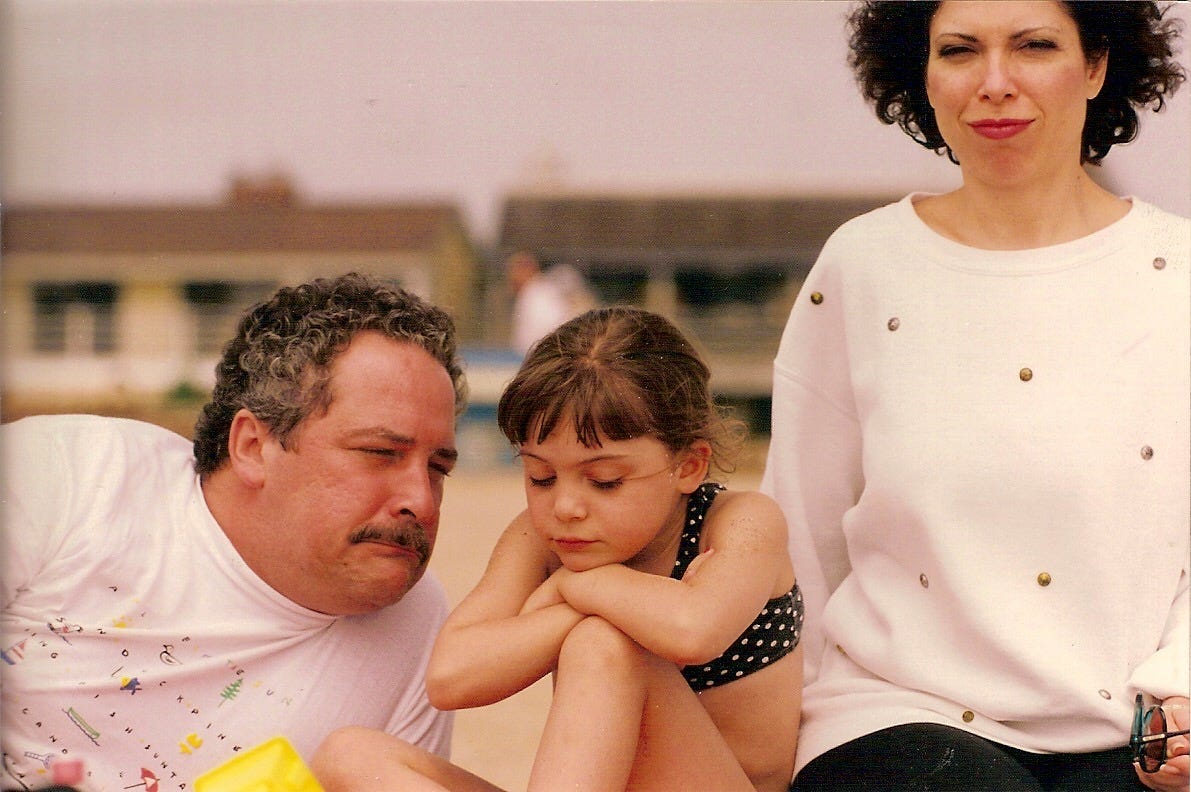
A beach-day parenting moment: John and I trying to model empathy while helping seven-year-old Julia discover that a small shift in attitude can make a big difference.
Yet some realities proved more complicated than either of us expected.
Eventually, our marriage ended.
For many people, divorce becomes a story of blame. People choose sides. Old wounds harden into resentment. Every memory is rewritten through the lens of pain.
Thankfully, that was not our story.
Was there grief? Absolutely.
Disappointment? Plenty.
Confusion? Certainly.
Harsh words? At times.
But there was also grace.
With the help of our pastor, we sat together and prayerfully worked through the details of our separation. We talked about finances, property, parenting, and how we wanted to treat one another going forward. We did not do it perfectly, but we both desired to act with integrity and kindness.
One of the most important lessons I learned from that season is that acceptance is not the same thing as agreement, understanding, or approval.
Acceptance simply says:
“I see your humanity. I acknowledge your struggle. I refuse to stop caring about you.”
As the years passed, our relationship changed shape.
We were no longer husband and wife, but we remained connected emotionally and spiritually in ways we never could while we were married. We shared conversations about family, parenting, aging, and life's challenges. We celebrated holidays together, gathered with family, and continued to care deeply about one another's well-being.
One of the greatest gifts John gave me was his blessing of my future happiness.
He loved my husband Rod and was genuinely glad to see me loved, supported, and partnered in ways he knew he could not provide. That was not easy for either of us, yet it reflected the genuine affection and respect that remained between us.
He didn’t want me to suffer.
I didn’t want him to suffer.
That kind of grace does not come naturally.
It comes from recognizing that every human being is carrying burdens, disappointments, and battles we may never fully understand.
One lesson I’ve learned over the years is that healing does not always come from getting answers. Sometimes it comes from making peace with the fact that some questions will remain unanswered. Maturity is not always finding certainty. Sometimes it is learning to live with mystery while choosing love anyway.
People sometimes ask how faith survives disappointment.
My answer is that faith was never built on getting everything I wanted.
My faith did not answer all my questions.
It did not erase the grief.
It did not magically resolve every tension.
What it did provide was a place to stand when life unfolded differently than I had hoped.
It reminded me that God’s presence is not dependent on perfect outcomes.
I believe God loved John.
I believe God loved me.
And I believe God walked beside both of us through joy, confusion, heartbreak, healing, and loss.
As I’ve grown older, I’ve come to believe that one of the signs of emotional maturity is the ability to hold two seemingly contradictory truths at the same time.
I can grieve the loss of my marriage and be grateful for it.
I can acknowledge the pain and still honor the person.
I can wish things had been different and still celebrate the good that came from them.
I can miss someone and be at peace.
In my coaching work, I have seen the same principle play out repeatedly. The healthiest leaders, spouses, parents, and friends are not those who avoid tension. They are those who learn to hold it without becoming bitter.
They can hold truth and compassion.
Grief and gratitude.
Loss and love.
Disappointment and faith.
Life taught me that not every story gets a tidy ending.
Some stories leave us with unanswered questions.
But if we’re fortunate, they also leave us with compassion, wisdom, humility, and gratitude.
When I think of John today, I do not think first about the pain.
I think about Julia.
I think about laughter.
I think about family.
I think about the many people whose lives he touched.
I think about a man who was deeply loved.
And I think about a complicated love story that taught me more about grace than I could have learned any other way.
Looking back, that’s what John’s life left with me.
Compassion.
Wisdom.
Gratitude.
And a faith that endured.
For that—and for him—I thank God.
Author’s Note: I share this story with gratitude and respect for John, our daughter Julia, and the many family members and friends who loved him. My purpose is not to revisit old debates or settle unanswered questions. It is simply to reflect on what love, loss, forgiveness, and faith taught me—and to honor a man who played an important role in my life.
Leadership Reflection
Most of us are carrying something unresolved.
Perhaps it is grief over a person, a relationship, a dream that never came to be, a career disappointment, a health challenge, or a season of life that ended too soon.
Perhaps it is not grief at all, but the tension of holding two opposing realities at the same time.
You may love your work and be exhausted by it.
Feel grateful for your success and uncertain about your future.
Believe in someone and be disappointed by their behavior.
Feel called to a new opportunity while mourning what you must leave behind.
Leaders are often required to hold complexity without rushing to simplify it.
Take a few moments to reflect:
What loss, disappointment, or unresolved grief am I carrying today?
What two seemingly opposing realities am I trying to hold at the same time?
How is this affecting me emotionally?
How is it impacting my relationships?
How is it influencing my leadership, decision-making, energy, or performance?
What would it look like to acknowledge both realities rather than choosing one over the other?
Growth often begins when we stop demanding that life be simple and instead learn to hold complexity with honesty, courage, and grace.
Thank you Terri. It's good to hear from others who seek to make sense, and find joy in what's difficult in life. I appreciate how you model living from a creative arts perspective, turning all your life's joys and struggles into beautiful poetry and paintings that helps us all appreciate the tapistry.
“I see your humanity. I accept that we all have struggles and I care about you”….we can hold the struggle and the love. This is a very wise sharing of our life journey.